
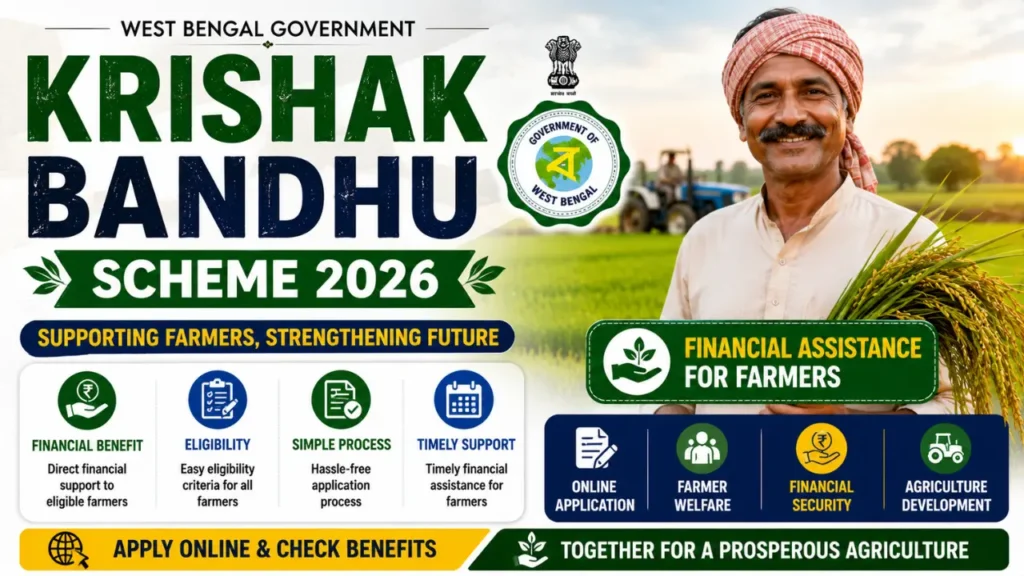
Farming requires regular investment in seeds, fertilizers, and water, which often creates a financial burden. We regularly meet local cultivators who struggle to arrange these initial expenses before the planting season begins.
To provide direct financial support to agricultural families, the state government transfers monetary assistance straight into their bank accounts. The Krishak Bandhu scheme is designed to ensure that farmers do not have to compromise on their crop quality.
For registered farmers, this initiative has brought wonderful relief to rural households across West Bengal. It is one of the most reliable welfare programs currently running for the agriculture sector.
Quick Answer: Krishak Bandhu Overview
| Target Beneficiaries | Farmers and registered Sharecroppers of West Bengal |
| Expected Assistance | Up to ₹10,000 per year (As per past official data) |
| Payment Frequency | Typically distributed in Kharif and Rabi seasons |
| Official Information | West Bengal State Portal (Egiye Bangla) |
Understanding the General Eligibility Rules
To apply for this financial benefit, you need to prove your connection to the agricultural land you cultivate. The agriculture department has outlined specific document requirements so that genuine cultivators face no trouble.
If you own the land, you must have the latest Record of Rights, commonly known as Parcha in our state. The land must be registered under your name in the local block land records system.
If you are farming on government-distributed land, you can submit your valid Patta document. The Krishi Prajukti Sahayak at your village level usually handles the verification of these documents.
Rules for Sharecroppers and Unrecorded Cultivators
Even if you do not own the land but work as a sharecropper, you may still be eligible for this state support. You will need to provide your registered Bargadar document to claim the seasonal benefits.
For unrecorded sharecroppers, past notifications have provided an option to submit a self-declaration form certified by the local panchayat. We always recommend keeping your land documents updated at the block office to avoid rejection.
How to Check Krishak Bandhu Status Using Voter ID
Traveling to the local agriculture office just to check your payment status can take valuable time away from farming. The state government has provided an online tracking system that you can access directly from a mobile phone.
You do not need to memorize any long application number for this process. Your regular identity documents, such as your Voter ID card, can act as your tracking number on the state agriculture portal.
Note: Ensure that the Voter ID number you enter matches exactly with the one submitted during the form fill-up. A single typing mistake usually results in a ‘No Data Found’ message.
Step-by-Step Mobile Tracking Process
To start the tracking process, open your mobile internet browser and visit the official state portal. Look for the specific section designated for registered farmer information or status checking.
Once the tracking window opens, select the Voter ID option from the available dropdown menu. Carefully type your complete identity card number in the provided blank space without adding any extra spaces.
Complete the basic security check or captcha, and click the search button. If your details are properly uploaded in the system, your farmer profile and the current payment phase will appear on the screen.
Understanding Your Payment Status Messages
When your dashboard loads, check the transaction status column. If the status shows ‘Approved’, it generally means your land documents have been verified, and the payment is scheduled for the upcoming seasonal transfer cycle.
If you see a ‘Pending’ message, your application is likely still under review at the local Assistant Director of Agriculture (ADA) office. This happens when block officers are still cross-checking records.
A message reading ‘Account Invalid’ or ‘Transaction Failed’ typically points to a bank account issue. In such cases, you may need to visit your bank branch to ensure your account is active and mapped for Direct Benefit Transfers.
Along with securing seasonal farming support, safeguarding your family against unexpected hospital bills is also a priority. We advise rural households to verify their details in the Swasthya Sathi Card 2026 Apply Online Name List to keep their medical coverage active.
Offline Application Process and Document Submission
If your online status shows no records, or if you are applying for the first time, an offline registration process is available. You can usually submit your documents through the local agriculture office in your block.
The blank annexure form is generally available at the Assistant Director of Agriculture (ADA) office. It is advisable to collect and submit the form well before the peak sowing season begins to avoid a last-minute rush.
Alternatively, the state government often sets up special agriculture desks during the periodic Duare Sarkar outreach camps. You can submit your filled application directly at these ward-level camps when they are active in your area.
How to Fill the Registration Form
The application form is typically available in both Bengali and English. Ensure that you write your name exactly as it appears on your active bank passbook to avoid potential mismatches during the transfer process.
You will need to mention your cultivable land holding area in acres or decimals. Registered sharecroppers (Bargadars) usually need to fill out a specific self-declaration section attached to the main application.
Safety Warning: Government officials generally do not call applicants to ask for bank OTPs or ATM PINs to process scheme installments. If you receive a phone call promising fast approval in exchange for financial details, it is likely a scam.
Mandatory Documents for Verification
Submitting the correct supporting documents is a mandatory part of the application process. Generally, every photocopy attached to the form should be self-attested with your full signature.
Applications can sometimes face delays if bank details or land records are outdated. Below is a standard checklist of documents typically required for the block-level verification process.
| Document Name | Purpose and Condition |
|---|---|
| Voter ID Card | Used as a primary identity proof and for tracking status. |
| Aadhaar Card Copy | Generally required for Direct Benefit Transfer mapping. |
| Bank Passbook Front Page | Should clearly show the active account number and IFSC code. |
| Land Records (Parcha/Patta) | Required to verify the active agricultural connection. |
Expected Payment Structure and Area Matrix
The agriculture department usually calculates financial assistance based on the total area of cultivable land you possess. This support is generally distributed in two phases, corresponding to the Kharif and Rabi crop seasons.
Based on past official guidelines, farmers holding one acre or more of agricultural land can expect a maximum support of up to 10,000 rupees per year. This is typically divided into two seasonal installments of 5,000 rupees each.
For cultivators who own less than one acre of land, the state usually provides proportional financial support. Previous notifications indicate a minimum expected base payment of around 4,000 rupees annually for marginal farmers.
Pro Tip: Always verify that your savings account is actively mapped with the NPCI server for Direct Benefit Transfer. Without an active DBT link, your seasonal installment might fail even if your application status shows approved.
The Krishak Bandhu Death Benefit (KBD)
Farming involves daily physical risks, and the sudden loss of an earning member can deeply impact a rural family. To address this, the scheme includes a conditional death benefit for the registered cultivator’s family.
If a registered farmer or sharecropper, typically between the ages of 18 and 60, passes away, their legal heir can apply for a one-time compensation. Past records show this compensation can be up to 2 lakh rupees after proper document verification by the block officer.
Alongside agricultural assistance, the state runs welfare programs dedicated to the female members of the household. We advise eligible women in farming families to check the Lakshmir Bhandar Scheme 2026 to explore options for independent monthly support.
Frequently Asked Questions
How much land is generally required to get 10,000 rupees?
To be eligible for the maximum expected assistance of 10,000 rupees per year, your recorded agricultural land should generally be equal to or greater than one acre. Smaller land holdings receive a proportional amount based on official calculations.
Can a sharecropper’s family claim the death benefit?
Yes, registered sharecroppers who possess a valid Bargadar document are usually considered eligible. In the event of their unfortunate demise (typically between 18 to 60 years of age), the nominated family member can apply for the compensation.
What should I do if my online status shows account invalid?
An invalid account status usually means the banking system has rejected the direct transfer. You should visit your home bank branch, submit a copy of your Aadhaar card, and request the manager to enable DBT receiving on your account.
Disclaimer: BengalEduHub is an independent educational guidance portal. We do not represent the West Bengal Agriculture Department. All scheme figures, eligibility conditions, and guidelines discussed here are derived from past public circulars and are subject to change. Always verify current details from the official block office.