
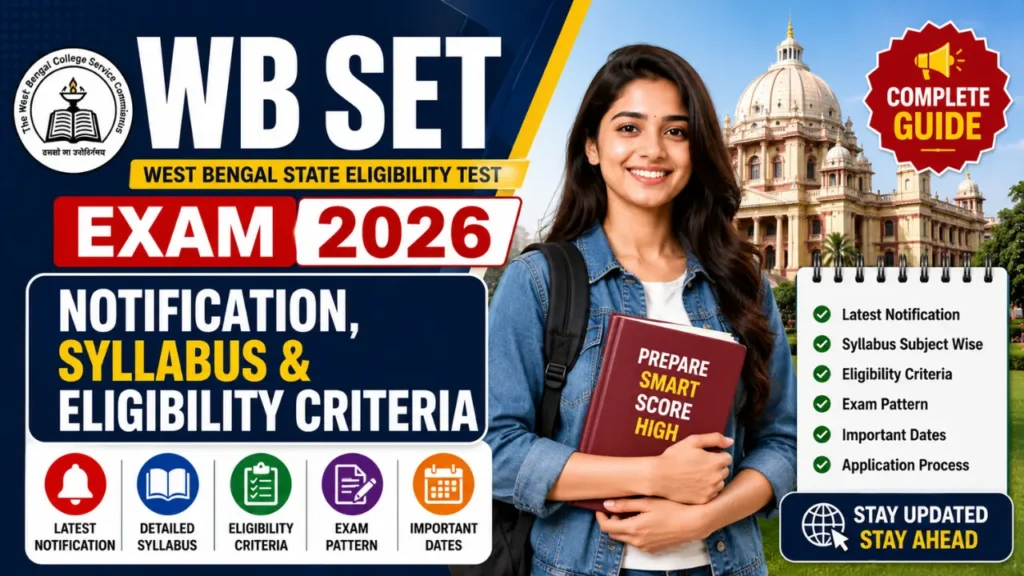
WB SET Exam 2026 Notification, Syllabus & Eligibility Criteria

WB SET Exam 2026 Notification & Syllabus

Securing an Assistant Professor position in state-aided colleges requires clearing a highly specialized eligibility benchmark. The upcoming WB SET Exam 2026 Notification & Syllabus is currently the most heavily searched academic framework among post-graduate candidates aspiring for a prestigious career in higher education.

The West Bengal College Service Commission serves as the primary state nodal agency mandated by the University Grants Commission to conduct this examination. Since this state-level test mirrors national standards, candidates must meticulously understand the specific academic percentage rules and structural guidelines before initiating their preparation.

WB SET 2026 Examination Snapshot

Conducting Authority West Bengal College Service Commission
Target Designation Assistant Professor (Colleges and Universities)
Mode of Examination Offline OMR Based Assessment
Official Web Portal WBCSC Online Portal

Detailed Eligibility Criteria for WB SET 2026

Unlike standard administrative or clerical government jobs, the state eligibility test imposes extremely rigid academic barriers. The fundamental requirement dictates that an applicant must hold a master’s degree or an equivalent post-graduate qualification from an institution officially recognized by the University Grants Commission.

Candidates pursuing a parallel career in school-level teaching often simultaneously prepare for broader state examinations. For those specifically targeting primary school roles with distinct qualification setups, reviewing the WB Primary TET 2026 Eligibility & Syllabus provides a comprehensive understanding of state teaching hierarchies.

Mandatory Academic Percentage Rules

The commission rigorously evaluates the minimum percentage secured in the post-graduation degree. Unreserved general category and economically weaker section candidates must have secured at least fifty-five percent marks without any rounding off in their master’s degree.

Standard academic relaxations are constitutionally provided to candidates belonging to scheduled castes, scheduled tribes, other backward classes, and transgender categories. These specific reserved categories are legally eligible to apply with a minimum of fifty percent marks in their master’s degree.

Candidates who have appeared for their final master’s degree exams or are waiting for their final year results are also legally permitted to apply. However, such provisionally admitted candidates must complete their post-graduation degree within two years from the date of the state eligibility test result declaration.

Age Limit Clarification

One of the most defining characteristics of the state eligibility test is the absence of an upper age barrier. According to established national and state regulatory norms, there is absolutely no upper age limit mandated for candidates applying for the assistant professor position through this examination.

This flexible age policy significantly benefits working professionals, research scholars, and late-stage academicians seeking to transition into permanent collegiate teaching roles without encountering standard age-related disqualifications.

Examination Pattern and Technical Mechanics

The state eligibility test operates on a strictly offline, multiple-choice objective evaluation mechanism. The commission traditionally conducts the comprehensive assessment across two distinct papers during a single, uninterrupted continuous session on the scheduled examination day.

To ensure absolute fairness and standardized evaluation across the state, the question paper medium is fundamentally bilingual. The objective questions are prominently printed in both English and Bengali languages, except for domain-specific language subjects like Hindi, Sanskrit, or Urdu.

Paper I: Teaching and Research Aptitude

The first paper serves as a generalized mandatory assessment designed to critically evaluate the teaching capability and research aptitude of the prospective educator. The structural design aims to test the candidate’s cognitive abilities, reading comprehension, and general academic awareness.

Applicants are required to attempt exactly fifty objective-type questions in this section. This foundational paper carries a total weightage of one hundred marks, and candidates are officially allotted a precise one-hour timeframe to complete it on their omr sheets.

Paper II: Subject Specific Domain Knowledge

The second paper is entirely subject-specific, thoroughly evaluating the candidate’s deep academic command over their chosen post-graduate specialization. Candidates must select their specific domain subject from the exhaustive list officially provided by the commission during the online application process.

This specialized section comprises one hundred compulsory multiple-choice questions, contributing a massive two hundred marks to the final evaluation. The administrative guidelines allocate a dedicated two-hour uninterrupted duration for completing this advanced domain assessment.

Examination Paper Total Questions Maximum Marks Time Duration
Paper I (General Aptitude) Fifty Compulsory Questions One Hundred Marks One Hour
Paper II (Specific Subject) One Hundred Compulsory Questions Two Hundred Marks Two Hours
Total Assessment Phase One Hundred Fifty Questions Three Hundred Marks Three Hours (Combined)

Marking Scheme and Evaluation Metrics

The academic evaluation mechanics strictly mirror the standardized national frameworks established by the University Grants Commission. Every correctly answered question in both paper one and paper two systematically awards exactly two marks to the candidate’s total aggregate tally.

A massive strategic advantage for candidates appearing in this state examination is the complete absence of any negative marking. Incorrect responses or unattempted circles on the omr sheet do not result in any fractional mark deductions, empowering applicants to confidently attempt the entire paper.

Many post-graduate scholars actively preparing for such rigorous eligibility examinations often require steady financial backing for purchasing advanced research materials. Securing state aid through initiatives like the Swami Vivekananda Scholarship 2026 provides crucial monetary support to maintain their uninterrupted academic focus.

Detailed Breakdown of the Examination Syllabus

A strategic approach to clearing the state eligibility test requires a micro-level understanding of the prescribed academic syllabus. The commission ensures that the curriculum strictly maintains absolute parity with the updated syllabus guidelines drafted by the university grants commission.

This identical syllabus structure allows post-graduate candidates to simultaneously prepare for both national and state-level eligibility tests without diverging their academic focus. The syllabus is categorically divided into general aptitude and subject-specific domains.

Paper I: Core General Units

The general paper comprises ten distinct conceptual units designed to evaluate a candidate’s holistic academic and cognitive aptitude. Each unit is systematically structured to carry equal weightage, meaning five questions are typically drafted from each distinct section.

To maximize scoring potential in this compulsory paper, candidates must rigorously practice mathematical reasoning, data interpretation, and logical deduction sequences. The table below outlines the ten official core units constituting the first paper.

Unit I: Teaching Aptitude Unit VI: Logical Reasoning
Unit II: Research Aptitude Unit VII: Data Interpretation
Unit III: Reading Comprehension Unit VIII: Information and Communication Tech
Unit IV: Communication Skills Unit IX: People, Development and Environment
Unit V: Mathematical Reasoning Unit X: Higher Education System

Mastering fundamental mathematics and logical reasoning for this paper provides an additional strategic advantage. Candidates building these strong foundational skills often easily clear subordinate administrative screening tests, frequently reviewing the WBPSC Clerkship Recruitment 2026 Syllabus & Eligibility as a highly secure parallel career option.

Paper II: Subject Specialization Domains

The second paper strictly evaluates advanced, master’s degree-level theoretical knowledge. The commission officially recognizes thirty-three distinct academic subjects ranging from classical literature to advanced scientific domains for the state eligibility test.

Candidates must carefully align their chosen paper two subject with their formal post-graduation degree specialization. The table below highlights some of the most highly competitive and widely opted subjects in this examination.

Bengali and English Literature Mathematical and Physical Sciences
History and Political Science Life Sciences and Chemical Sciences
Geography and Environmental Sciences Commerce and Economics
Sociology and Education Computer Science and Applications

Aspirants are strongly advised to download the comprehensive, topic-wise syllabus exclusively from the commission’s authorized portal to avoid studying outdated academic materials. Analyzing previous year question papers remains the most authentic method to decode the difficulty level of these specialized subjects.

Salary Structure and Remuneration Guidelines

Securing the state eligibility test certificate opens the direct gateway to permanent assistant professor positions across government-aided colleges and universities. The remuneration for these highly esteemed academic positions is strictly governed by the University Grants Commission pay matrix adopted by the state government.

Newly appointed assistant professors are officially placed in Academic Pay Level 10. According to the revised state administrative guidelines and ROPA implementation, this level guarantees a highly lucrative and mathematically structured monthly compensation package.

The table below outlines the factual monthly salary breakdown, including the standard basic pay and supplementary government allowances authorized for collegiate academic staff.

Salary Component Authorized Calculation (Level 10)
Initial Basic Pay Fixed at ₹57,700 per month
Dearness Allowance (DA) Calculated as per current state orders
House Rent Allowance (HRA) Calculated at 12% of the Basic Pay
Medical Allowance (MA) Standard ₹500 fixed per month
Estimated Monthly Gross Approximately ₹65,000 to ₹72,000

Frequently Asked Questions

Is a B.Ed degree mandatory to apply for WB SET?

No, a bachelor of education degree is absolutely not required for this examination. The fundamental academic requirement is strictly a master’s degree in the relevant subject from a recognized university.

What is the lifetime validity of the SET qualification certificate?

Once a candidate successfully clears the state eligibility test, the qualifying certificate awarded by the commission remains legally valid for a lifetime for applying to assistant professor roles within the state.

Are candidates from other Indian states eligible to apply?

Yes, citizens from other states are entirely eligible to participate. However, they will be universally treated as unreserved general category candidates regardless of their original reservation status in their home state.

Does the examination enforce any negative marking?

The commission does not implement any negative marking system. Candidates are highly encouraged to attempt all one hundred and fifty questions across both papers without fearing fractional mark deductions.

Conclusion

Clearing the state eligibility test demands rigorous academic discipline and a deep conceptual command over both general aptitude and specific post-graduate subjects. Aspirants should strictly follow the official commission guidelines and avoid relying on outdated preparation materials.

Consistent practice of previous year question papers and a focused approach toward the high-scoring first paper significantly enhances the probability of crossing the final evaluation cutoff marks.


Disclaimer: BengalEduHub is a completely independent informational portal and holds no official affiliation with the West Bengal College Service Commission or the University Grants Commission. The syllabus, salary structures, and eligibility norms detailed here are for general informational guidance based on historical and public administrative records.

Leave a Comment

Your email address will not be published. Required fields are marked *